Choosing a Chocopie Cake Production Line in 2026 is not just a question of hourly output. It means matching mixing, baking, cooling, filling, enrobing, and packaging to the product you actually sell. A small change in cake diameter can affect belt spacing, filling accuracy, and chocolate coverage. Details matter.
The Food and Agriculture Organization’s 2023 report, The State of Food and Agriculture, estimates that 13.2% of food is lost between harvest and retail. That figure does not measure losses inside a cake factory, but it highlights why process control and yield deserve attention. The International Federation of Robotics reported 4,281,585 industrial robots operating worldwide in 2023, up 10% from 2022. This is broad manufacturing data, not a bakery-specific forecast. Still, it reflects growing investment in automation that food producers can evaluate carefully.
A useful purchasing review starts with verified capacity, changeover time, energy use, cleaning access, and the supplier’s service record. Ask for a product trial using your recipe, coating thickness, and target pack format. Watch the line, not only the presentation slides. A quoted speed can look impressive while hiding rejected cakes or difficult maintenance. I have to admit, published figures rarely show those everyday problems. Compare documented test results, operator requirements, spare-parts availability, and realistic production targets before choosing. For 2026, the strongest Chocopie Cake Production Line is not necessarily the fastest. It is the one that repeatedly makes the required cake, safely and consistently, with costs your team can verify.
Before comparing equipment, define the cake precisely. Record diameter, height, weight, cake moisture, filling ratio, coating thickness, and package format. A 45-gram cake needs different depositing and cooling control than a 70-gram product. State your target output per hour, operating shifts, changeover time, and acceptable waste. Keep the numbers realistic. An ambitious target can hide expensive bottlenecks.
Map the process from mixing to final packing. Check whether the line supports your batter viscosity, filling temperature, enrobing method, cooling length, and sealing material. For stable quality, specify temperature ranges and weight tolerances, not vague phrases such as “high precision.” Ask for trial data using a recipe close to yours. Inspect the crumb, filling position, coating cracks, and package seals after several hours.
In 2026, production goals should include traceability, energy use, labor needs, and future recipe changes. Digital monitoring can record temperatures, weights, alarms, and downtime, but data alone cannot fix poor calibration. Leave room for maintenance access and operator training. This is often underestimated. A compact line may save floor space yet reduce cleaning convenience. Review sanitation procedures with your quality team, then calculate total ownership cost over five years. No forecast is perfect. Recheck it after pilot production.
Capacity planning should begin with demand, not machine speed. For example, 12 million cakes yearly require about 3,125 pieces per hour, assuming 300 operating days, 16 hours daily, and 80% OEE. OEE means overall equipment effectiveness. PMMI’s recent packaging machinery reports identify labor shortages, automation, and changeover time as major investment factors. Therefore, the selected line should exceed average demand without creating excessive idle capacity. A 10–15% growth allowance may be practical, but it is not automatically correct.
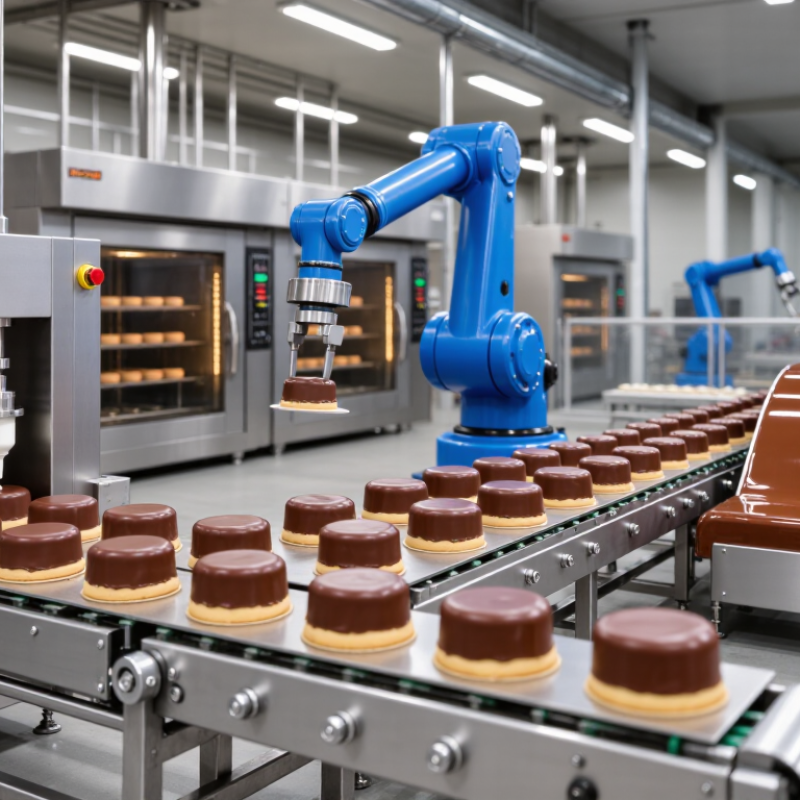
Map the complete process before comparing suppliers: ingredient dosing, mixing, depositing, baking, cooling, cream filling, enrobing, inspection, wrapping, and case packing. Measure each step separately. Cooling often becomes the hidden bottleneck, especially when coating temperature must remain stable. Include cleaning time, product changeovers, rejected pieces, and planned maintenance in the calculation. Codex food hygiene guidance recommends a preventive, hazard-based control approach, so inspection points should be visible in the layout.
FAO’s 2023 food-loss reporting estimates that 13.2% of food is lost before retail globally. That figure is not a direct factory benchmark, but it shows why yield deserves attention. A neat spreadsheet can still lie. Trial production should record actual batter weight, breakage, coating loss, and packaging downtime. The first capacity estimate may need correction after real tests. That is useful, not embarrassing.
Choosing a chocopie cake production line in 2026 requires more than comparing hourly capacity. Mordor Intelligence estimates the global bakery products market will continue expanding through 2029, increasing pressure on consistent output and flexible recipes. Forming equipment should control dough weight within a narrow tolerance. A five-gram variation can affect filling volume, coating coverage, and package appearance.
Baking performance deserves close testing. Measure oven temperature across each zone, not only at the control panel. The International Energy Agency reports that industrial heat remains a major energy-use area, so energy recovery and insulation should influence the purchase.
After baking, cooling must prevent condensation before filling and coating. Filling pumps should handle viscosity changes without creating air pockets. Small pockets become visible defects after chocolate coating.
Packaging equipment must match the product’s actual fragility. PMMI’s packaging industry research repeatedly identifies automation, labor efficiency, and flexible formats as major investment drivers.
Check sealing pressure, film alignment, date coding, and reject accuracy during a full-speed trial. A line rated at 300 pieces per minute may perform differently with sticky cream and humid weather.
That assumption can fail. Request production data from similar recipes, including changeover time, unplanned stops, waste, and cleaning duration.
I would also reserve space for inspection equipment and future packaging formats. It costs less than rebuilding the line later.
When selecting a chocopie cake production line in 2026, inspect food safety before chasing output. Ask how batter, filling, and coating move through enclosed zones. Look for hygienic stainless surfaces, tool-free access, and clear separation between raw and finished products. Small gaps can hold chocolate residue. Request cleaning records, allergen controls, temperature logs, and traceability data. Do not accept attractive claims without factory evidence.
Automation should reduce handling without hiding critical decisions. Servo-controlled depositing, vision checks, and automatic reject systems can improve consistency. However, sensors need calibration, and software needs trained operators. Ask for changeover times using your actual recipes and tray sizes. Energy deserves a line-by-line review. Compare oven insulation, heat recovery, compressed-air demand, and standby consumption. A fast line may waste power during short production runs. That detail is easy to miss.
Maintenance planning often separates a reliable investment from an expensive interruption. Check access to belts, pumps, nozzles, heaters, and control panels. Obtain maintenance intervals, spare-part lead times, and technical support terms in writing. Run a trial with real production staff. Record cleaning time, restart behavior, noise, and product loss. During one assessment, a line performed well but required awkward access beneath the coating section. That flaw was not obvious during the demonstration. Leave room for doubt, because polished tests can hide everyday maintenance fatigue.
A neutral 100-point procurement benchmark focused on food safety, automation, energy use, and maintenance needs.
Food safety receives the highest weighting because hygienic design, allergen control, temperature monitoring, traceability, and cleanability directly affect product compliance. Automation reduces process variation and labor dependence, while energy efficiency and maintenance access help control long-term operating costs. The scores form a practical 100-point evaluation model and do not represent any company or brand.
How to Choose a Chocopie Cake Production Line in 2026?
Supplier reliability should be tested before equipment pricing. Request 12 months of uptime records, customer references, and documented factory acceptance tests. Ask how quickly technicians respond to faults. Spare-part availability matters, especially for cooling tunnels, enrobing pumps, sensors, and wrapping units. The 2024 Packaging Machinery Shipments Study identifies labor availability and equipment uptime as major industry concerns. A polished presentation is not proof. A spreadsheet can still lie.
Calculate total cost across ten years, not only the purchase invoice. Include installation, training, utilities, molds, film waste, maintenance, software updates, and production downtime. The U.S. Department of Energy reports that compressed-air leaks can waste 20–30% of compressor output. Check air pressure stability and leak-test procedures during acceptance. Motor efficiency also deserves attention. Energy losses become visible on every monthly bill.
Line performance should match the recipe and target market. Measure pieces per minute, cream weight accuracy, cooling time, changeover duration, and reject percentage. The FAO’s 2022 food-loss report estimates that 13.2% of food is lost before retail, showing why process control deserves serious attention. Run a full trial with real batter, filling, coating, and packaging materials. Record temperatures at each zone. Do not accept only an ideal-speed demonstration. I would leave a small capacity margin, because actual production is rarely perfect.
| Evaluation Dimension | Weight | What to Evaluate | Evidence and Decision Criteria |
|---|---|---|---|
| Supplier reliability and project delivery | 20% | Relevant experience with layered cakes, depositing, cooling, enrobing, and packaging integration; project schedule; installation and commissioning capability. | Request references for comparable products and line layouts, a project schedule with defined milestones, a responsibility matrix, and documented commissioning procedures. Check whether the proposed scope clearly assigns responsibility for interfaces between machines. |
| After-sales service and spare parts | 10% | Availability of technical support, maintenance documentation, operator training, and critical spare parts. | Confirm support hours, escalation contacts, spare-parts lead times, warranty exclusions, and training hours in writing. Set response and resolution targets in the contract according to the plant’s location and production schedule. |
| Total cost of ownership (TCO) | 25% | Purchase price plus installation, utilities, labor, maintenance, consumables, spare parts, sanitation, and expected downtime costs. | Compare quotations on the same scope and operating assumptions. Use the same service life, operating hours, product mix, energy prices, labor rates, and financing assumptions for each proposal. Identify exclusions, optional equipment, and recurring costs. |
| Guaranteed line performance | 15% | Rated output, product dimensions, acceptable weight variation, changeover time, and performance across the agreed product and package formats. | Require a written guarantee for saleable output at the agreed product specification—not just individual machine speed. Define the test duration, product recipe, packaging format, yield measurement, and acceptance-test conditions before ordering. |
| Yield, rejects, and overall equipment effectiveness | 10% | Start-up waste, rejects, unplanned stops, and the method used to calculate availability, performance, and quality. | Agree on definitions and measurement points. Review a representative factory acceptance or site acceptance test report where available. Treat any target as project-specific and verify it using the planned product, crew, and operating conditions. |
| Food safety and hygienic design | 10% | Cleanability, product-contact materials, allergen changeover procedures, guarding, and suitability for the plant’s food-safety plan. | Review equipment drawings, material specifications, cleaning instructions, and access for inspection. Confirm applicable local regulations and site requirements with the plant’s food-safety team; do not assume a certification alone guarantees suitability. |
| Controls, integration, and maintainability | 10% | Controls compatibility, alarm history, data access, line synchronization, operator access, and maintenance access. | Request the control-system architecture, interface list, electrical documentation, backup and restore procedure, and training plan. Verify that alarms and production data can be accessed by the plant’s authorized staff. |
| Suggested TCO calculation | — | TCO over the evaluation period = equipment purchase + engineering and installation + commissioning and training + energy and utilities + labor + maintenance and spare parts + consumables + sanitation and changeover costs + downtime and lost-production costs − residual value. | |